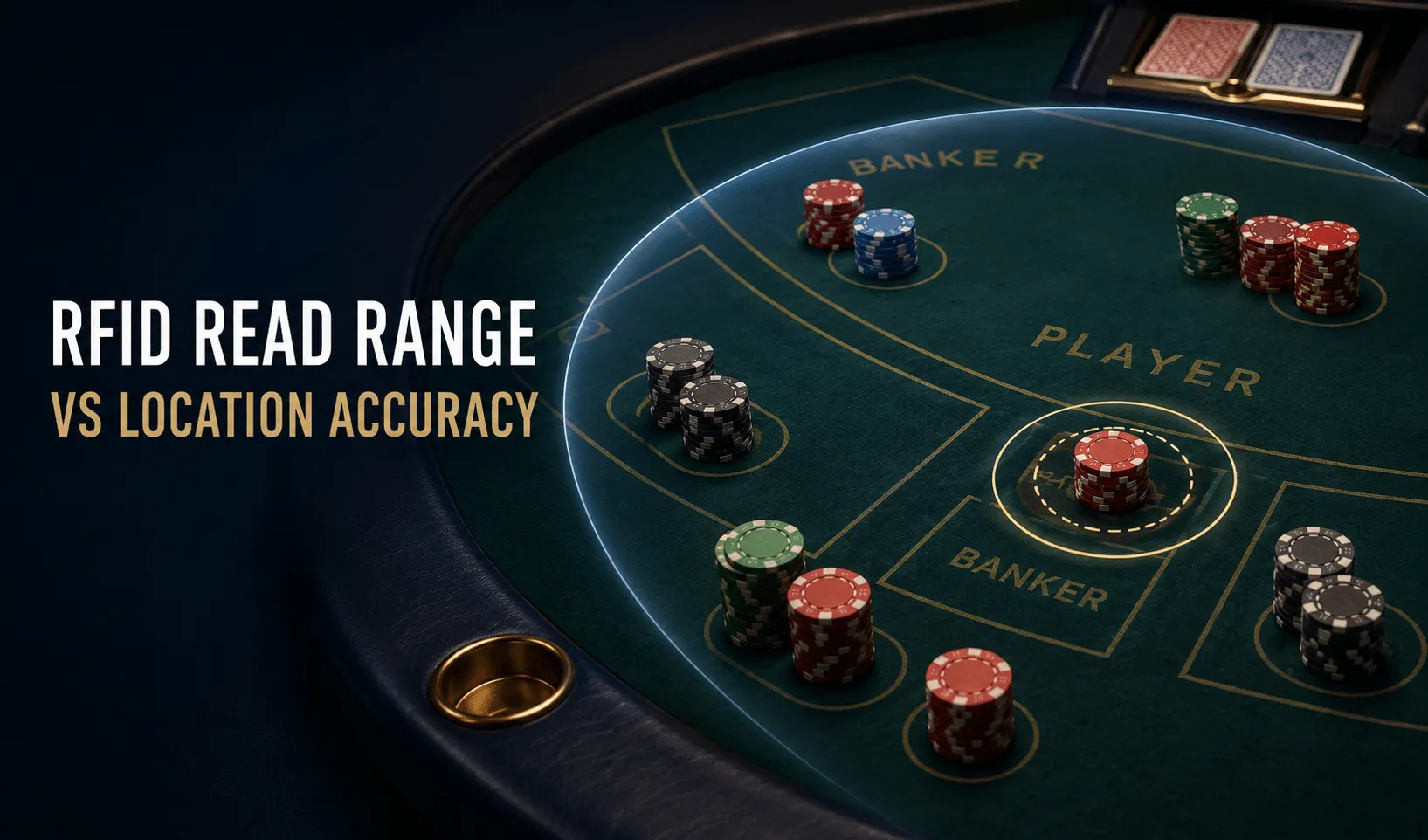
RFID technology is often evaluated by one straightforward question: how far can the reader detect the tag?
For warehouse inventory, logistics and asset tracking, a longer reading distance can be valuable. Casino table operations, however, present a different challenge. The system may need to determine not only whether a chip is present, but also which betting position it belongs to, when it entered the reading area and whether it should be included in the current game event.
In this environment, maximum reading distance is not necessarily the most important performance indicator. A precisely controlled reading zone can be more useful than a powerful reader capable of detecting chips across a larger area.
Identification and Location Are Different Functions
A passive RFID reader receives data from tags located within its electromagnetic field. When a tag responds, the reader can capture its electronic identifier and pass that information to the application software.
This confirms that the tag was detected. It does not automatically provide its exact physical coordinates.
Most conventional passive HF and UHF RFID systems identify the reader or antenna that detected a tag. The application then infers that the tagged object was located somewhere within that antenna’s reading zone.
This distinction matters on a gaming table because several betting positions may be separated by only a short distance. A system that detects every chip on the table but cannot reliably associate each one with the correct betting area provides limited operational value.
Accurate table-level tracking therefore depends on controlled antenna coverage, zone separation and event-processing logic—not simply the reader’s maximum range.
Why Casino Tables Are Difficult RFID Environments
Casino chips create a demanding RFID application because they are small, frequently stacked and constantly moved by players and dealers.
The reading environment may contain:
- Multiple chips placed directly on top of one another
- Mixed denominations within the same stack
- Adjacent betting positions
- Metal table supports and decorative components
- Electronic displays and card-handling equipment
- Human hands passing over the antenna area
- Chips positioned at the edge of a reading zone
- Several antennas operating within the same table
Each of these conditions can influence RFID performance.
Chip stacks may alter antenna tuning or reduce the amount of energy received by individual tags. Nearby conductive materials can change the shape of the radio-frequency field. Overlapping antenna zones can also cause the same chip to be detected by more than one reader.
Consequently, performance demonstrated with a single chip in an open test environment may not represent performance on a completed casino table.
A Larger Read Zone Can Create New Problems
Increasing reader power may appear to be a simple way to improve detection. In practice, it can expand the reading field beyond its intended boundary.
This may produce unintended reads from:
- Chips held in a player’s hand
- Chips placed in an adjacent betting position
- Dealer inventory stored near the table
- Chips moving past the outside edge of the table
- Nearby equipment using a compatible RFID frequency
These detections are not necessarily technical failures. The reader may be operating correctly by identifying every tag within its field. The problem is that the reading field no longer matches the operational area the software is supposed to monitor.
For this reason, RFID table design often involves limiting and shaping the reading zone instead of maximizing it.
Precise Reading Zones Matter at the Betting Position
A table-level RFID system should define what each antenna is expected to monitor.
Depending on the game and table layout, separate reading zones may be assigned to:
- Player betting positions
- Banker, player or tie wagers
- Side-bet areas
- Dealer chip trays
- Buy-in and cash-out locations
- Chip verification points
The antenna layout must provide sufficient coverage inside each intended area while minimizing overlap with neighbouring positions.
On an integrated RFID baccarat table, the table structure, antenna placement and betting layout therefore need to be designed together. Installing readers beneath a conventional table without considering its materials and zone geometry may produce inconsistent results.
Software also plays a role. If two antennas detect the same chip, the application needs rules for deciding which reading should be associated with the current event. These rules may consider antenna identity, timing, signal behaviour and the previous state of the chip.
Reading Range Is More Useful for Inventory Applications
A wider interrogation area can still be valuable in casino operations. Its suitability depends on the task.
Inventory-oriented applications may include:
- Counting chips in a storage area
- Checking a chip tray before transport
- Monitoring transfers between controlled departments
- Detecting tagged items at a cage checkpoint
- Supporting periodic inventory reconciliation
In these situations, the goal may be to identify all authorized tags within a defined container, room or passage rather than assign every chip to a small betting position.
UHF RFID is commonly considered for wider item-management reading zones. ISO/IEC 18000-63 defines an air interface for passive RFID systems operating in the 860–960 MHz range. However, authorized UHF channels and reader power limits vary across jurisdictions, so hardware and configuration must be checked for the intended market.
Even in an inventory application, a longer range still requires control. Directional antennas, shielding, physical separation and appropriate reader-power settings can help prevent chips outside the intended checkpoint from being included.
Antenna Design Can Matter More Than Advertised Range
An RFID tag and reader do not operate independently of their physical environment.
Actual performance depends on factors such as:
- Tag antenna dimensions
- Antenna position inside the chip
- Chip material and construction
- Reader antenna geometry
- Distance between the chip and antenna
- Chip orientation
- Stack height and density
- Reader transmission power
- Nearby conductive materials
- Interference from adjacent antennas
This is why a fixed reading-distance claim should be treated as a test result for a particular configuration—not as a guaranteed result for every installation.
A tag described as readable from several metres in an open environment may behave differently when embedded inside a compact gaming chip and placed in a dense stack. Conversely, a carefully engineered short-range antenna may provide more consistent results within a specific betting area.
RFID Data Still Needs Game Context
Detecting a chip identifier is only the first stage of table data collection.
To create a useful operational record, the system may also need to determine:
- Which table detected the chip
- Which betting position was involved
- When the chip entered or left the zone
- Whether betting was still open
- Which game round the detection belonged to
- Whether the wager was accepted, returned or settled
- Whether the chip was authorized for that venue or activity
Other table devices may provide separate information. Card-handling equipment can record or support dealing events, while roadmap displays present game history. Backend software must reconcile these event streams using consistent timestamps and defined workflow rules.
Operators should therefore evaluate the complete casino equipment and table-technology ecosystem, rather than selecting readers, tables, card shoes and displays solely from their individual specification sheets.
How a Casino RFID System Should Be Tested
A realistic acceptance test should reproduce actual operating conditions.
The test plan should include:
- Single-chip detection
- Verify that individual chips can be detected across the entire intended zone.
- Stacked-chip detection
- Test different stack heights, denominations and orientations.
- Zone-boundary testing
- Place chips at the edges of the betting area and between neighbouring antennas.
- Unintended-read testing
- Confirm whether chips outside the target zone are detected.
- Movement testing
- Reproduce normal dealer and player movements, including chips being placed, removed or rearranged.
- Equipment-interaction testing
- Operate nearby displays, card-handling devices and table electronics during the test.
- Failure-recovery testing
- Check reader behaviour following a power interruption, network failure or temporary antenna disconnection.
- Event-reconciliation testing
- Verify that detected chips are assigned to the correct table position and game event.
Results should record the exact reader, antenna, chip construction, power setting, stack arrangement and table materials used. Without this information, statements such as “supports fast multi-chip reading” are difficult to evaluate objectively.
Better Tracking Begins with a Clear Operational Question
Before choosing an RFID frequency or reader, the operator should define what the system must know.
If the requirement is to determine which chips have been placed within a small betting position, controlled zone coverage is critical.
If the requirement is to count a larger group of chips passing through a cage checkpoint, a wider interrogation area may be more appropriate.
If the venue needs both functions, different antenna configurations—or even different RFID technologies—may be required at different operational stages.
The best RFID system is therefore not necessarily the one with the longest advertised reading range. It is the one whose reading field, hardware design and application logic match the event that the operator needs to record.
Conclusion
RFID read range and location accuracy should not be treated as the same performance measure.
A reader can identify a chip without determining its precise position. In casino table operations, where neighbouring betting zones are close together, excessive reading range can introduce unwanted detections and make event attribution more difficult.
Reliable casino chip tracking depends on controlled antenna zones, suitable table construction, calibrated reader settings and software capable of associating each detection with the correct operational context.
For that reason, RFID equipment should be tested as part of the completed table and workflow—not evaluated only by the maximum distance shown on a product specification sheet.
This article references technical standards and public information published by the International Organization for Standardization — ISO/IEC 18000-63:2021, GS1 RFID Standards, GS1 US RFID Implementation Resources, and RFID Journal. These materials were used to verify the operating principles of passive RFID, the distinction between tag identification and physical location, and the role of readers and read zones. Reference to these materials does not imply certification, endorsement or regulatory approval of any product.