
Casino table games are not only defined by rules. They also depend on physical equipment that makes each game playable, readable and organized on a live casino floor.
A blackjack game needs cards, a shoe, a discard tray, a chip tray and clear betting positions. A baccarat game needs cards, a shoe, betting areas for Player, Banker and Tie, and sometimes a roadmap display. A roulette game needs a wheel, a ball, a numbered layout and enough space for different chip placements.
This is why casino table games equipment is more than decoration. The equipment supports how the dealer works, how players place bets, how chips move and how each round is settled.
For anyone trying to understand live casino table games, looking at the equipment is one of the easiest ways to understand how the games actually work.
What Counts as Casino Table Games Equipment?
Casino table games equipment includes the physical tools used to operate live table games. The exact equipment depends on the game, but common items include:
- gaming tables;
- casino chips;
- playing cards;
- card shoes;
- discard trays;
- chip trays;
- roulette wheels;
- roulette balls;
- printed table layouts;
- dealer markers;
- table displays or roadmap screens.
These items may look simple, but each one has a clear purpose.
The table gives the game a fixed structure.
The layout shows where wagers are placed.
The chips represent betting value.
The cards or wheel create the game result.
The chip tray and discard tray help the dealer keep the table organized.
Without these tools, live table games would be slower, less clear and harder to supervise.
Casino venues commonly group games such as blackjack, baccarat, roulette, craps and poker-based games under the wider category of table games. These games use different rules, but they all depend on physical table equipment to run properly.
Playing Cards: The Core of Blackjack and Baccarat
Cards are the most basic equipment in blackjack and baccarat.
In blackjack, players try to get a hand value closer to 21 than the dealer without going over 21. The game uses playing cards to form each player’s hand and the dealer’s hand. Because players may hit, stand, double down or split pairs, the table must keep each hand and each wager clearly separated.
In baccarat, the game is built around two main hands: Player and Banker. Players usually bet on Player, Banker or Tie before the cards are dealt. The winning side is the hand closer to nine.
Although both games use cards, the equipment setup is not exactly the same. Blackjack is built around individual player decisions. Baccarat is built around comparing two hands. This is why the same deck of cards can be used in different table games, but the table layout and dealing process must match the specific game.
Card Shoes: Why Dealers Do Not Always Hold the Deck
A card shoe is a dealing device used to hold multiple decks of cards and allow the dealer to draw cards one at a time. It is commonly used in casino card games such as blackjack and baccarat.
The purpose of a card shoe is practical. It keeps the cards in a fixed position, helps the dealer deal smoothly and supports continuous game operation when multiple decks are used.
In blackjack, a card shoe is usually placed on the dealer side of the table. The dealer draws cards from the shoe and deals them according to the table rules.
In baccarat, card shoes are also common, especially because baccarat often uses multiple decks. A larger shoe can reduce the need to change or reshuffle cards too frequently during the game.
Modern venues may also use an electronic card shoe when they need stronger card-reading support, dealing data connection or smart table integration. The key point is not that every casino table must use electronic equipment, but that the shoe position and table design should match the game’s real dealing process.
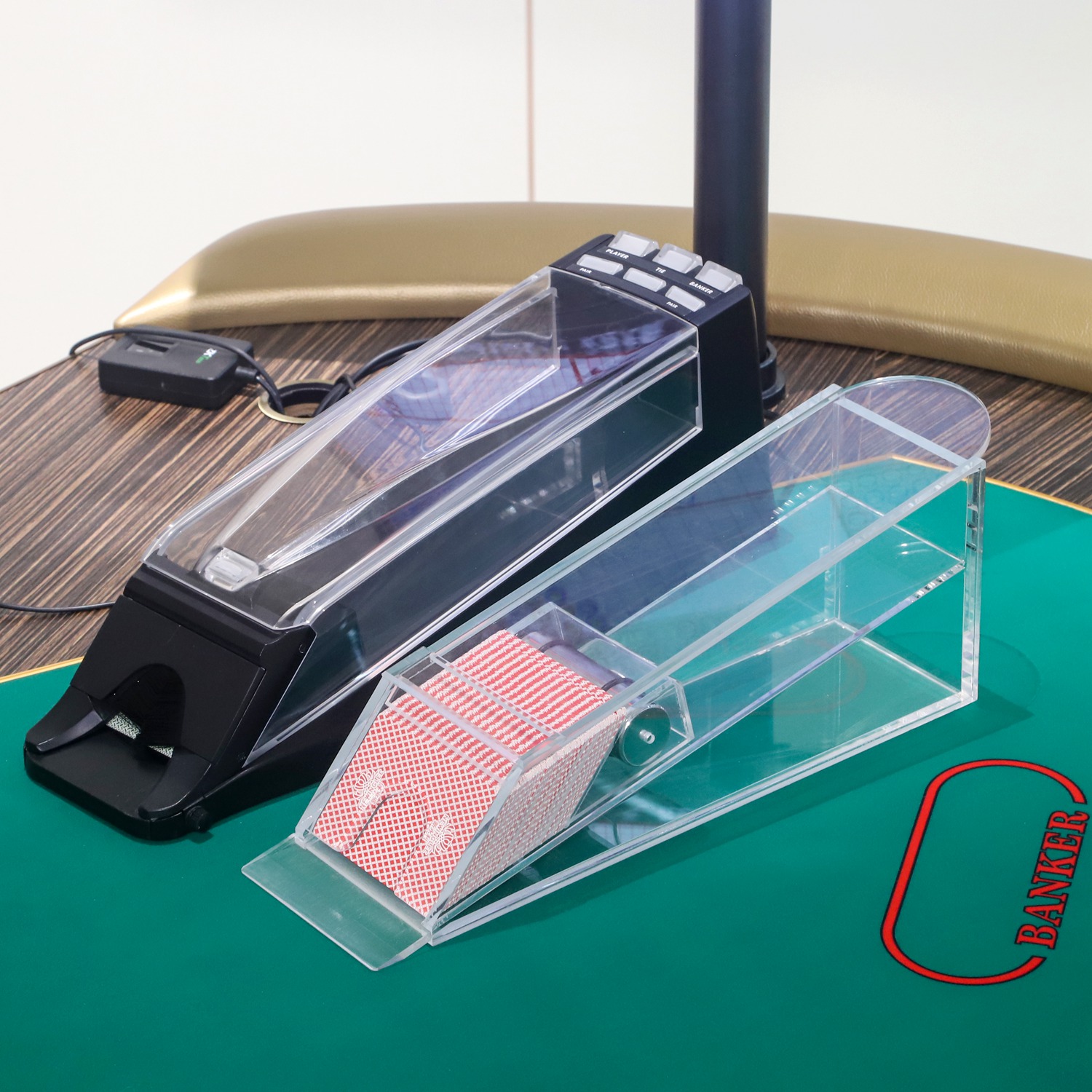
Discard Trays: Keeping Used Cards Organized
A discard tray is used to collect cards after they have been dealt and finished in a round.
This is a small piece of equipment, but it matters for table order. In a live casino environment, cards need to be handled consistently. Used cards cannot be left loosely around the table because that would make the game area messy and harder to manage.
In blackjack, cards from completed hands are moved to the discard tray. In baccarat, used cards are also collected after the round. The discard tray helps separate used cards from undealt cards and keeps the dealer’s work area clean.
For players, the discard tray may not seem important. For dealers and floor staff, it is part of maintaining a clear table process.
Casino Chips: The Basic Tool for Betting and Settlement
Casino chips are one of the most visible pieces of equipment in table games. Players use chips to place wagers, receive payouts and manage their balance at the table.
Chips are easier to handle than cash during live table games. They can be stacked, moved, counted and placed on betting areas more efficiently. On a busy table, this makes a major difference.
In blackjack, chips are placed in individual betting circles or marked player positions. Additional chips may be added when a player doubles down, splits a pair or places a side bet.
In baccarat, chips are placed on Player, Banker, Tie or other optional betting areas.
In roulette, chips can be placed on numbers, lines, corners, columns, dozens, colors or other betting sections. Because roulette allows many different betting combinations, chip placement needs to be especially clear.
For commercial casino use, chip quality matters. Chips should be durable, easy to identify and suitable for repeated handling. In modern casino operations, some venues also use RFID chips for identification, tracking and inventory support.
CTSOK provides casino chips designed for casino table games, including RFID options that can support chip authentication, tracking and management in compatible systems.
Chip Trays: More Than a Storage Box
The chip tray is the dealer’s main chip storage area at the table. It usually holds chips in different denominations so the dealer can pay winners, collect losing wagers and manage chip exchange during the game.
A chip tray must be easy for the dealer to reach but also positioned in a way that keeps the table secure and organized.
In blackjack, the chip tray is usually placed in front of the dealer, near the card shoe and discard tray.
In baccarat, the chip tray supports repeated settlement of Player, Banker and Tie wagers.
In roulette, the chip area must support a different rhythm because many small chip placements may be settled after every spin.
A good chip tray position helps the dealer work smoothly. A poor position can make the table feel crowded or slow down settlement.
This is why chip tray placement should be considered during table design, not added as an afterthought.
Roulette Wheel and Ball: The Center of Roulette Equipment
Roulette is different from blackjack and baccarat because it is not a card game. The main equipment is the roulette wheel and ball.
Players place chips on a numbered layout before the croupier spins the wheel. The ball eventually lands in one numbered pocket, and the result is settled based on the winning number.
A roulette wheel is usually placed next to the betting layout. The croupier needs enough space to operate the wheel, announce results, collect losing bets and pay winning bets.
The roulette ball is small, but it is central to the game. Without the ball and wheel, the numbered layout has no result mechanism.
Roulette also has different wheel formats. European roulette normally has a single zero, while American roulette includes both zero and double zero. This difference changes the wheel structure and affects the table layout used for the game.
Because roulette has many possible betting positions, the equipment must be arranged carefully. The wheel must be visible, and the betting layout must leave enough space for chips to be placed and read clearly.
Printed Table Layouts: The Surface That Explains the Game
The printed table layout is one of the most important parts of casino table games equipment.
It tells players where to place chips.
It tells the dealer how the table is organized.
It separates different wager types.
It makes the game easier to read from above.
On a blackjack table, the layout usually shows each player’s betting area. It may also show insurance, side bets or dealer rule text.
On a baccarat table, the layout usually shows Player, Banker, Tie and possible side bet areas.
On a roulette table, the layout includes numbered spaces and outside betting sections such as red or black, odd or even, high or low, dozens and columns.
A clear layout helps reduce confusion. A crowded layout can make the table harder to operate. For commercial venues, layout design should be based on the actual game format, number of seats, dealer workflow and chip movement.
This is why casino table layout is not just a visual design issue. It is a functional part of the equipment.
Roadmap Displays and Table Screens
Some casino table games also use display equipment.
Baccarat is the most common example. Many baccarat tables use roadmap displays to show previous game results. These displays are not part of the basic rule of baccarat, but they are often used in casinos because many players like to follow previous results while watching the table.
Other table screens may show table limits, game information or connected system data, depending on the venue’s setup.
Displays should not block the dealer’s workflow or make the table crowded. They should be placed where players can see them clearly without interfering with chips, cards or table operation.
In modern casino table games, display equipment is often used as a support tool. It does not replace the table, cards or dealer. It adds information visibility around the game.
Why Equipment Design Matters in Commercial Casino Use
Casino table games equipment needs to work under repeated daily use.
Players lean on the rail.
Dealers handle cards and chips for long hours.
Chips move across the layout constantly.
Cards are dealt, collected and replaced.
Tables are cleaned, inspected and used again.
Because of this, commercial casino equipment must be durable, readable and practical.
A table that looks good in photos may not perform well if the dealer area is too crowded. A chip tray may slow down the game if it is poorly positioned. A card shoe may be inconvenient if it does not match the dealer’s natural reach. A table layout may look attractive but become confusing if betting areas are too close together.
In real casino use, small design problems can become daily operating problems.
That is why equipment should be evaluated by function, not only appearance.
How Equipment Supports the Live Table Experience
Live casino table games depend on clear interaction between the dealer, players and table equipment.
The cards create the result in blackjack and baccarat.
The wheel creates the result in roulette.
The chips show the wager.
The layout organizes the game.
The dealer controls the round.
The table equipment keeps everything in place.
When the equipment is well designed, the game feels smoother and easier to follow. Players know where to place chips. Dealers can move naturally. Floor staff can observe the table more clearly.
When the equipment is poorly designed, the opposite happens. Betting areas feel crowded, chip stacks become harder to read and dealer movement becomes less efficient.
This is why professional casino table games equipment is designed around real game flow.
Choosing Equipment for Different Casino Table Games
Different games need different equipment priorities.
For blackjack, the main focus should be clear player positions, card shoe placement, discard tray position, chip tray access and enough room for split or double-down wagers.
For baccarat, the focus should be clear Player, Banker and Tie betting areas, smooth card dealing, chip tray access and optional display support.
For roulette, the focus should be wheel quality, layout clarity, chip placement space and croupier operating area.
The best equipment choice depends on the game, the room style, the number of players, the dealer workflow and the level of customization needed.
A commercial venue should not treat all casino table games as the same. Each game has its own movement, equipment and layout logic.
Final Takeaway
Casino table games are not only about rules. They are also about equipment.
Cards, chips, shoes, trays, wheels, layouts and displays all help live table games run clearly and consistently. Each piece of equipment has a practical role. Some tools help create the result. Some help organize wagers. Some help the dealer manage the table. Others help players understand the game flow.
Blackjack needs equipment that supports player decisions.
Baccarat needs equipment that supports clear betting and smooth card dealing.
Roulette needs equipment that supports the wheel, ball and numbered layout.
Understanding the equipment behind casino table games makes it easier to understand why professional table design matters. The table is not just where the game happens. It is the working structure that keeps the game readable, playable and organized.