A card shoe is one of the simplest-looking pieces of equipment on a casino table.
Its traditional job is straightforward: hold a prepared group of playing cards and allow the dealer to draw them in sequence.
That basic function has not disappeared. Baccarat and blackjack tables still need a practical way to hold multiple decks and present cards to the dealer. The Venetian’s published baccarat rules, for example, describe play using an eight-deck shoe, illustrating how closely the shoe is tied to normal baccarat dealing procedure.
What has changed is what can happen around the dealing process.
An electronic card shoe can retain the familiar physical dealing workflow while adding card-recognition, data-output or system-integration functions. That makes the difference between manual and electronic shoes less about changing the game itself and more about changing how much information the table can produce.
What Does a Traditional Card Shoe Actually Do?
A traditional dealing shoe is primarily a mechanical device.
Cards are shuffled according to the casino’s approved procedure and then loaded into the shoe. A weighted mechanism or internal pressure system keeps the remaining cards positioned near the dealing outlet, allowing the dealer to draw cards one at a time.
Its main functions are therefore physical:
- hold multiple decks;
- keep cards organized;
- present the next card to the dealer;
- support a consistent dealing motion;
- keep undealt cards separate from used cards.
Card shoes appear across multiple regulated table-game procedures. Pennsylvania’s gaming regulations, for example, separately reference procedures for dealing cards from manual dealing shoes across several table-game variants.
The shoe itself does not need to know which card has been dealt.
It only needs to deliver the card correctly.
An Electronic Card Shoe Adds a Data Layer
An electronic card shoe still needs to perform that same physical job.
The dealer still removes cards from the dealing outlet. The cards are still physically dealt onto the table. The underlying baccarat or blackjack rules do not automatically change simply because electronic components have been added.
The difference is that an electronic shoe can detect or record information as cards pass through the dealing process.
Depending on the design and system configuration, that information can then be used to:
- identify cards being dealt;
- record card sequence;
- calculate or verify game results;
- send information to a table display;
- create game-history records;
- connect dealing information with a casino management platform.
CTSOK’s current electronic card shoe documentation describes its product as adding electronic card recognition and system connectivity while retaining normal dealer dealing procedures. It also lists API-based integration with external casino management systems.
This distinction is important:
The physical shoe deals the cards.
The electronic layer creates data about the cards being dealt.
Electronic Card Shoe and Automatic Shuffler Are Not the Same Device
This is one of the most common misunderstandings.
An electronic card shoe and an automatic card shuffler solve different problems.
A shuffler is designed to randomize the cards.
A dealing shoe is designed to hold cards and provide them to the dealer.
Electronic recognition can be added to the dealing shoe without turning it into a card-shuffling machine.
Gaming regulations also treat these concepts separately. Pennsylvania defines an automated card shuffling device as mechanical or electronic equipment that automatically randomizes playing cards, while its table-game provisions separately refer to manual and automated dealing shoes.
So when evaluating equipment, buyers should ask two separate questions:
How are the cards shuffled?
and
How are the cards dealt and recorded?
One piece of equipment does not necessarily perform both functions.
Why Baccarat Is Closely Associated With Card Shoes
Baccarat is particularly suited to multi-deck dealing shoes because the game commonly uses several decks during a session.
The Venetian’s published baccarat rules specify an eight-deck shoe.
The purpose is operational: instead of handling a single deck manually, the prepared cards can remain organized inside one dealing device while the dealer works through the shoe.
For an electronic baccarat shoe, the same physical arrangement provides an opportunity to capture information as cards leave the shoe.
A connected system can therefore follow a sequence such as:
Card leaves shoe
→ card is identified
→ card information is recorded
→ Player/Banker hands are reconstructed
→ result data becomes available to connected systems
The cards themselves are still dealt according to the baccarat procedure.
The difference is that the digital system no longer needs to depend entirely on a person manually entering every result afterward.
What Information Can the Shoe Send?
The exact output depends on the hardware and integration.
A properly connected electronic shoe may provide information related to:
- card identity;
- card order;
- dealing time;
- Player and Banker card sequence;
- completed game result;
- system status;
- error or exception records.
That data can potentially be consumed by another table system.
For example, a roadmap display needs a result before it can update the next baccarat outcome on screen.
A table-management platform may need a game result before it can compare the result with recorded wagers.
An audit or review system may need a historical sequence to reconstruct what was dealt during a particular round.
CTSOK states that its electronic shoe can connect with external management systems, while its FAQ describes real-time dealing records as supporting verification, audit trails and operational transparency.
However, these functions depend on the final integration. Purchasing an electronic shoe alone does not automatically create a complete casino management system.
The Shoe Is One Data Source, Not the Entire Smart Table
It is useful to think of a connected table as several separate information sources.
For example:
Electronic card shoe
Provides information about the cards.
RFID casino chips
Provide electronic identities associated with physical chips.
Table reader
Detects compatible chips within configured reading areas.
Casino management software
Receives and interprets information from connected devices.
Each source answers a different question.
The card shoe can help answer:
What cards were dealt?
RFID chip equipment can help answer:
Which chips were identified?
The table system can connect those records according to its configured workflow.
That distinction prevents an electronic shoe from being described as doing things it cannot independently do.
Why This Matters for Baccarat Result Displays
Baccarat tables often use result displays or roadmap screens.
Traditionally, results can be entered manually. With a connected electronic dealing system, the result generated from the card sequence can instead be transmitted to compatible display equipment.
The practical chain becomes:
Cards dealt → result recognized → result transmitted → roadmap updated
This reduces dependence on a separate manual result-entry step, provided the shoe and display system are designed to communicate with one another.
It also creates a consistent source of game-result information for multiple connected systems.
The roadmap display can receive it.
The table-management system can receive it.
The historical game record can retain it.
This is one reason card recognition becomes more useful when it is treated as part of an integrated table environment rather than as an isolated feature.
What Changes for the Dealer?
A good electronic shoe should not require the dealer to completely relearn the basic dealing process.
Cards still need to be loaded correctly.
The dealer still draws a physical card.
The card still travels from the shoe to the table.
The player experience remains centered on physical playing cards.
The electronic recognition takes place around that familiar process.
CTSOK explicitly positions its electronic card shoe around this principle: adding digital dealing records without changing traditional game rules or normal dealer practices.
This is important because technology that adds unnecessary steps to every deal can create a new operational problem instead of solving one.
Manual Shoe vs Electronic Shoe
The fundamental difference can be summarized simply.
FunctionManual Card ShoeElectronic Card ShoeHolds playing cardsYesYesSupports dealer card drawingYesYesRequires the dealer to physically deal cardsYesYesAutomatically provides electronic card dataNoDepending on systemCan connect dealing information to softwareNoYes, if integratedCan support automatic result dataNoDepending on configurationRequires electronic installationNoYesDepends on software integrationNoFor connected functions
The manual shoe is a dealing device.
The electronic shoe is a dealing device plus a data interface.
That is the most useful way to understand the upgrade.
Does an Electronic Shoe Automatically Improve Accuracy?
Not simply because electronics are present.
A connected card shoe needs to be tested as part of the complete installation.
Operators should evaluate factors such as:
- recognition method;
- supported playing cards;
- card orientation requirements;
- dealing speed;
- card-jam handling;
- error reporting;
- communication protocol;
- table-system compatibility;
- network behavior;
- software response to a missed read;
- maintenance access.
If the connected system receives an incorrect or incomplete reading, there also needs to be a defined exception procedure.
Technology works best when failures are detectable rather than silently accepted.
This is why buyers should evaluate not only whether a product can recognize cards but also what the system does when a card cannot be recognized correctly.
Can an Electronic Card Shoe Be Added to an Existing Table?
Sometimes.
The important question is not simply whether the shoe physically fits on the tabletop.
The project may also need:
- power;
- a data connection;
- a table terminal;
- cable routing;
- software integration;
- connection to a display or CMS.
CTSOK states that its electronic shoe can be adapted to most existing baccarat and gaming-table configurations, but the actual installation requirements depend on the selected table and connected system.
For a standalone installation, the physical change may be relatively small.
For a fully connected smart-table project, integration planning becomes much more important.
What Buyers Should Ask Before Choosing an Electronic Shoe
The best purchasing questions go beyond appearance.
How many decks does the game use?
Different table formats may require different capacities.
Baccarat commonly uses multi-deck shoes; The Venetian’s published baccarat game, for example, uses eight decks.
How are cards identified?
The recognition architecture should be compatible with the playing cards and the intended system.
Where does the data go?
Ask whether the output is intended for:
- a standalone terminal;
- roadmap display;
- table-management platform;
- central CMS;
- third-party software.
Is there an integration interface?
CTSOK’s current product specification lists a standardized API interface for external CMS integration.
What happens when recognition fails?
A serious system needs a defined error state and review procedure.
Is it a dealing shoe or a shuffler?
Do not assume the product randomizes cards unless that functionality is specifically provided and approved.
What maintenance is required?
The dealing channel and sensing components need to remain clean and accessible.
Where CTSOK Fits Into the Table Workflow
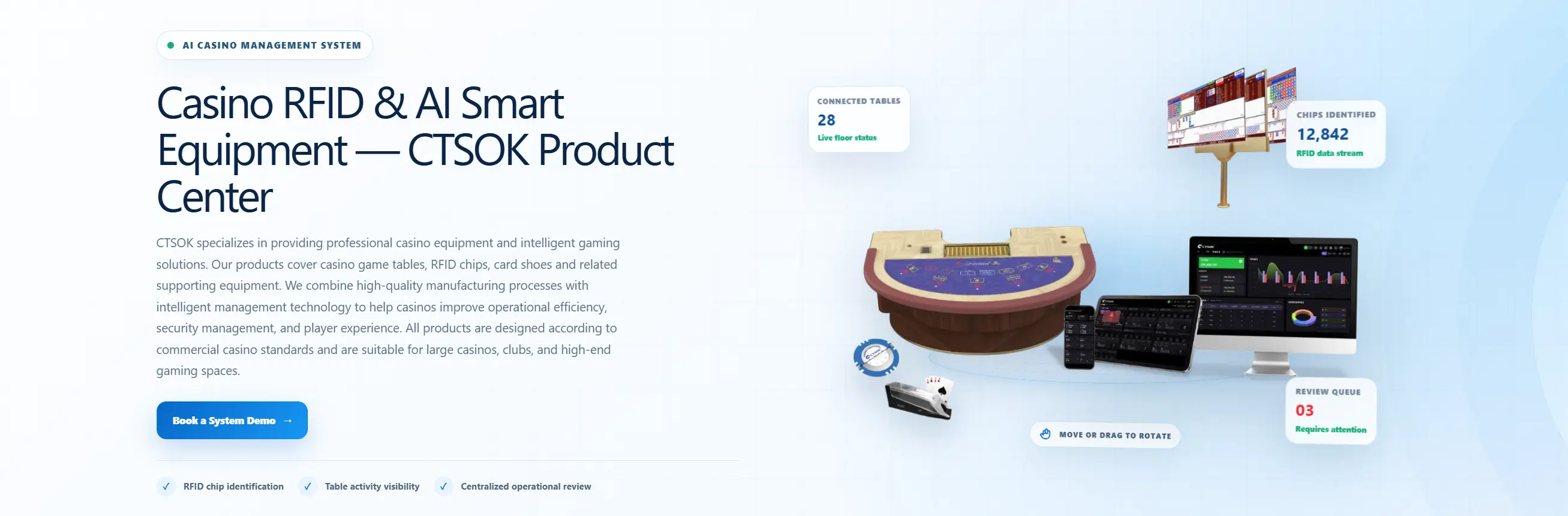
CTSOK provides an electronic card shoe designed to connect physical card dealing with digital table records. Its current product specifications describe card-recognition capabilities and standardized API integration for connected management environments.
For projects requiring a broader data layer, the shoe can be connected with CTSOK’s casino management system, where card information can become one source of table-operation data rather than remaining isolated at the dealer station.
The exact configuration depends on the project.
An operator might deploy:
Electronic shoe + roadmap display
or:
Electronic shoe + smart table + management platform
or simply:
Electronic shoe + local dealing terminal
The important point is to define the required workflow before selecting the hardware.
Final Takeaway
A traditional card shoe solves a physical problem:
How do we hold multiple decks and allow the dealer to deal them smoothly?
An electronic card shoe adds a second question:
Can we create reliable digital information while those cards are being dealt?
That is the real difference.
The electronic version does not need to replace the dealer, change baccarat rules or become an automatic shuffler.
Its value comes from connecting an ordinary physical action—drawing a card—to a digital record that other table systems can use.
For casinos moving toward connected table operations, that small change turns the card shoe from a passive card holder into a useful source of structured game data.