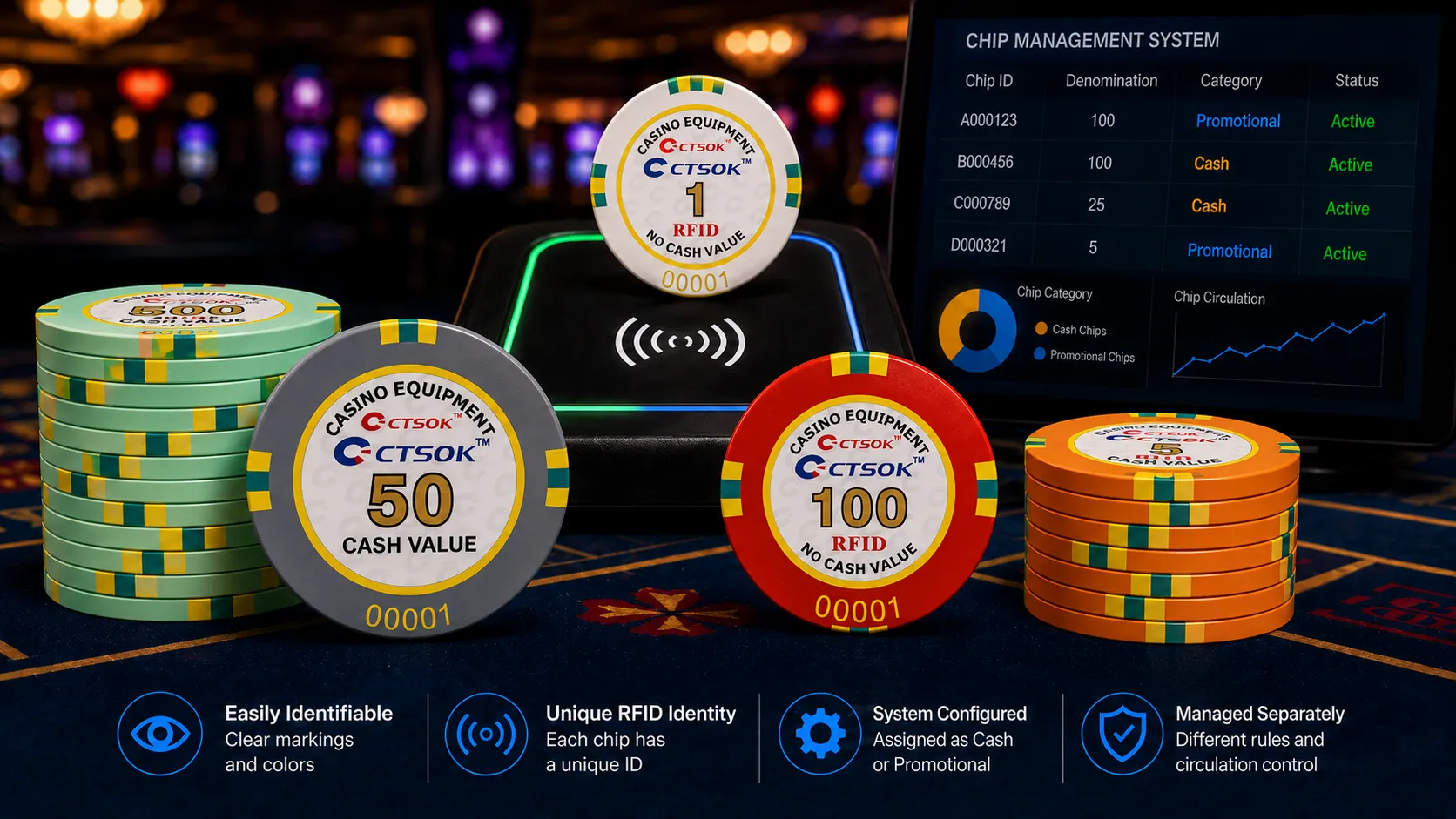
Two casino chips can display the same number, share a similar size and even be used on the same gaming floor, yet represent completely different obligations for the operator.
A standard cash-value chip normally forms part of the casino’s redeemable chip inventory. A promotional chip may be issued for a campaign, tournament or another controlled program and may not be redeemable as ordinary cash value. Even when both chips display a value of 100, they should not automatically enter the same inventory, redemption or accounting workflow.
This is why casinos need more than different chip colors. They need a reliable method for identifying what each chip represents, where it may be used and how it should be handled when it returns to the cage or table inventory.
RFID technology adds an electronic identity to the physical chip. When that identity is connected to a management platform, cash-value and promotional chips can be placed in separate system categories and handled through different operational workflows.
Cash-Value and Promotional Chips Are Not Financially Interchangeable
The terminology and legal treatment of casino chips vary by jurisdiction, but regulated markets commonly distinguish ordinary gaming chips from chips issued for limited promotional purposes.
Nevada provides one clear example. Its Regulation 12 defines a regular casino chip as a representative of value issued for use at table or counter games. Subject to the applicable rules, an issuing casino is generally required to redeem its own approved chips for cash or check.
Promotional chips are addressed separately. Under the same regulation:
- each side must conspicuously display “No Cash Value”;
- the chips may only be used for the promotion or tournament for which they were issued;
- they do not follow the same discontinued-chip redemption provisions as ordinary chips.
These requirements are specific to Nevada and should not be presented as a universal international standard. They nevertheless demonstrate why an operator cannot treat promotional and redeemable chips as one undifferentiated asset class.
A Printed Denomination Does Not Always Mean Cash Redemption
One common source of confusion is the number printed on a promotional chip.
A chip marked “100” may be permitted as a 100-unit wager under the terms of a promotion. That does not necessarily mean the holder can take the chip directly to the cage and redeem it for 100 units of cash.
The printed number may represent:
- a permitted promotional wagering amount;
- a tournament value;
- an internal rolling-chip value;
- a training or demonstration value;
- another operator-defined use.
The chip’s redemption treatment is determined by the applicable rules and program conditions, not by the printed number alone.
Nevada’s Gaming Control Board also notes that non-negotiable chips may have no monetary value outside the gaming establishment while still being used for promotional wagering. Winnings produced through their use can affect reported table-game revenue, making accurate accounting necessary even though the original promotional chip is not treated like an ordinary redeemable chip.
Why Visual Identification Is Still Necessary
Cash-value and promotional chips should normally be easy for dealers, cage personnel and supervisors to distinguish visually.
Depending on the project, visible differences can include:
- body color;
- edge inserts;
- denomination;
- serial number;
- operator artwork;
- campaign-specific design;
- “No Cash Value” wording;
- other approved markings.
These features help staff identify the chip during normal table activity without reading it electronically every time.
However, visual identification has practical limitations. Chips may be stacked with only their edges visible. Different chip series may use similar colors. A promotional campaign may adopt denominations already present in the cash-value inventory. Manual counts may also contain multiple chip types at the same location.
For that reason, color and artwork should be treated as the first identification layer—not the entire control method.
What RFID Adds to the Chip
RFID uses tags and readers to identify objects through radio-frequency communication. When an RFID chip enters a compatible reading area, the reader captures its electronic identity and sends that information to the connected software. RFID does not require the same direct optical line of sight as a printed barcode.
In a casino chip application, the electronic identifier can be associated with a backend record containing project-defined information such as:
- denomination;
- chip category;
- chip series;
- current status;
- issuance batch;
- inventory location;
- campaign assignment;
- other operational attributes.
The exact information stored directly in the RFID component and the information maintained in the database depend on the selected technology and system architecture. It is therefore more accurate to say that the chip’s RFID identity is linked to its operational record rather than claiming that every piece of management data is physically stored inside the chip.
Three Layers of Chip Classification
A connected RFID chip system can separate cash-value and promotional chips through three coordinated layers.
1. Physical markings
The chip provides immediate visual information through its color, denomination, serial reference, artwork and redemption wording.
A promotional chip may display “No Cash Value,” while a cash-value chip may use the standard design approved for the operator’s redeemable inventory.
2. Unique electronic identity
The reader identifies the individual chip through its RFID identifier.
This allows the system to distinguish two chips even when they:
- display the same denomination;
- belong to visually similar series;
- are counted within the same reading area;
- are stacked with other chips.
The electronic identity answers the question:
Which individual chip has been detected?
3. Backend category
The corresponding system record identifies how that chip should be treated.
For example, the backend can classify one identity as:
- cash-value chip;
- denomination: 100;
- active standard inventory.
Another identity can be classified as:
- promotional chip;
- promotional wagering value: 100;
- campaign series;
- No Cash Value handling.
The category gives operational meaning to the RFID identity.
A Practical Example
Consider two chips that both display the number 100.
Chip A: Standard cash-value inventory
Chip A is registered as a cash-value chip. Its record associates its RFID identity with the standard 100-unit denomination.
Depending on the casino’s approved procedures, it may pass through:
- cage issuance;
- table-bank inventory;
- player buy-in and wagering;
- payout;
- color-up;
- cage redemption;
- reconciliation.
Chip B: Promotional inventory
Chip B is registered under a promotional campaign. Its physical design includes “No Cash Value,” and its RFID identity belongs to a separate promotional series.
Its workflow may include:
- campaign allocation;
- controlled distribution;
- use at designated tables or during an approved activity;
- separate table or cage counting;
- campaign reconciliation;
- deactivation or withdrawal after the program.
Although both chips display 100, their financial treatment and reporting requirements are different.
The distinction is created by the combination of visible markings, electronic identity and backend configuration—not by denomination alone.
Where Separate Records Matter
The operational value of chip classification becomes clearer when the chips begin moving through the venue.
Issuance
Cash-value chips and promotional chips originate from different operational reasons.
A cash-value chip may be issued through the normal cage or table-bank process. A promotional chip may be distributed under the terms of a defined campaign.
Separate system categories allow the operator to record how many chips from each inventory were issued without combining the two totals.
Table use
When a connected reader identifies a chip at a table, the system can retrieve its configured category.
This can help staff determine whether the chip belongs to:
- regular table inventory;
- an approved promotional program;
- a designated chip series;
- an inactive or otherwise restricted group.
The system does not independently determine whether a wager is legally valid. It provides identification data that can support the operator’s approved procedures.
Inventory counting
A mixed physical count can contain chips from several denominations and categories.
RFID recognition can support batch identification, while the software groups detected chip identities according to their records. Cash-value inventory and promotional inventory can therefore remain separate in reports even when both are detected during the same operational count.
Redemption review
A promotional chip should not accidentally be processed as an ordinary cash-value chip merely because it displays a familiar denomination.
Electronic category identification gives cage or management personnel an additional reference when reviewing how the chip should be handled.
The final decision must still follow the casino’s internal controls and local regulations.
Campaign reconciliation
After a promotion, management may need to determine:
- how many promotional chips were issued;
- how many entered play;
- how many returned;
- how many remain outstanding;
- which campaign or batch they belong to;
- whether any promotional chips entered the standard cash inventory.
These questions are much harder to answer when promotional chips are recorded only by color or total face value.
Why Color Alone Is Not a Complete Control
Color remains useful, but it cannot identify an individual physical chip.
A red 100-value chip may be clearly different from a grey 50-value chip. However, visual inspection alone cannot reliably answer:
- which specific chip was detected;
- which production or campaign batch it belongs to;
- whether it is active or inactive;
- whether it has been configured as cash or promotional;
- where it was last identified by connected equipment.
RFID does not make physical design unnecessary. It adds a machine-readable identity to the visual design.
A well-planned chip project therefore uses both:
visible recognition for people and electronic identification for the system.
How the CTSOK Product Configuration Supports Separation
CTSOK’s RFID casino chips are designed for use with compatible readers and connected management platforms. Each chip can be associated with a unique electronic identity, while denomination, artwork, serial format and RFID configuration can be adapted to the project.
Within the supported backend configuration, chip identities can be assigned to cash or promotional categories. This allows chips intended for regular table circulation, promotional campaigns or other controlled programs to be identified and managed separately.
The connected casino management system combines RFID identification with chip issuance, redemption, reconciliation, inventory visibility, reporting and shift-management workflows. CTSOK’s published system description confirms that RFID chip identities are used to monitor chip movement and that operational processes such as issuance, redemption and reconciliation can be handled through the centralized platform.
The practical relationship is:
Physical chip → RFID identity → backend category → operating record
The physical chip is the instrument used at the table.
The RFID identity tells the system which chip has been read.
The backend category explains whether it belongs to the cash-value or promotional inventory.
The operational record shows how it has been handled through configured reading points and workflows.
RFID Identification Is Not Continuous GPS Tracking
RFID chip management should not be confused with continuous location tracking.
An RFID chip is detected when it enters the effective reading range of compatible equipment. That equipment may be installed in a chip tray, inventory reader, smart table or another controlled reading point.
The system can record identification events at those configured locations, but it does not automatically provide a continuous geographic position wherever the chip travels.
The visibility available to the operator depends on:
- the RFID frequency and protocol;
- reader and antenna placement;
- table or tray configuration;
- software integration;
- installed reading points;
- system permissions and reporting rules.
This distinction is important when explaining what RFID chip tracking actually means.
Technology Does Not Replace Regulatory Approval
A backend label does not decide the legal status of a casino chip.
A casino cannot make a chip cash-redeemable merely by selecting “cash chip” in software, nor can it satisfy all promotional-chip requirements by printing “No Cash Value” without following the applicable approval and internal-control process.
Nevada, for example, requires chips and modifications to be approved before issuance and requires applications to include drawings, specifications, the manufacturer and the intended use. Other jurisdictions may have different procedures.
Operators should confirm local requirements covering:
- chip design approval;
- required wording;
- redemption treatment;
- promotional use;
- system controls;
- issuance and reconciliation;
- retirement or destruction.
The product and software configuration should then be built around those approved requirements.
Final Takeaway
The difference between cash-value and promotional chips is not simply the difference between two colors.
It affects issuance, table use, inventory records, redemption procedures, campaign accounting and regulatory controls.
A reliable RFID management structure uses three layers:
- Visible markings that help staff recognize the chip.
- A unique RFID identity that allows connected equipment to identify the individual chip.
- A backend category that separates cash-value and promotional records and directs each chip into the appropriate workflow.
This approach gives casino operators clearer information without changing the familiar physical use of chips at the table.
Players continue placing physical chips. Dealers continue handling wagers and payouts. The difference is that the management platform can identify what each chip represents—and avoid treating two chips with the same printed value as the same financial instrument.