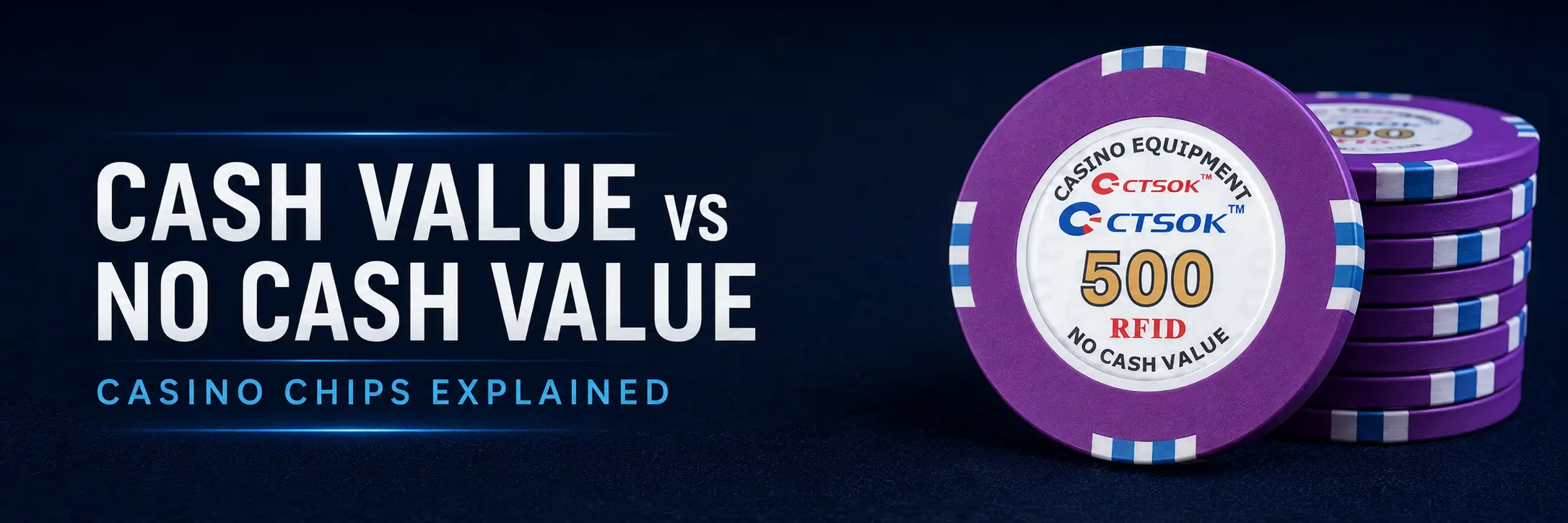
Casino chips may look similar in size and shape, but the words printed on their faces can indicate very different rules.
A chip carrying a number such as 100 or 500 is not automatically worth 100 or 500 units of cash. Its actual role depends on the chip category, the operator’s approved procedures and the conditions under which it was issued.
This distinction is especially important when casinos use separate chips for ordinary cash play, promotional activities, tournaments, training or equipment testing.
Cash-Value Casino Chips
A cash-value chip represents an amount that the issuing casino recognizes for wagering and redemption under its operating rules.
Players generally obtain these chips by exchanging cash or another accepted payment method at the casino cage or gaming table. After play, valid chips can normally be returned to the issuing casino for redemption.
However, a casino chip is not general legal tender. Its value and acceptance are tied to the issuing property and the applicable gaming rules.
A cash chip therefore needs more than a printed denomination. Operators also need procedures covering:
- Issuance and redemption;
- Authorized denominations;
- Chip inventory;
- Counterfeit detection;
- Damaged or obsolete chips;
- Suspicious transactions;
- Removal of discontinued chip series.
The exact requirements differ by jurisdiction. A chip design used in one casino should not automatically be assumed to meet the rules of another market.
Promotional Chips
Promotional chips are issued under specific campaign conditions rather than sold as ordinary redeemable gaming chips.
Depending on the promotion, a chip may be usable only:
- On selected table games;
- During specified dates;
- On designated wagers;
- For one wager only;
- By the person who received it;
- Without being redeemable for cash.
The words “Promotional Chip” or “No Cash Value” help distinguish these chips from regular cash chips, but the complete rules must still be communicated to the player.
For example, published promotional terms from Wynn Las Vegas state that its applicable promo chips are collected after the wager whether the wager wins or loses and cannot be used for tipping. That is one specific program, not a universal rule for every promotional chip.
Likewise, a California-approved Free Bet Chip activity requires the chips to state their represented value, “Promotional Chip” and “No Cash Value.” The applicable activity also defines eligible games, dates and other restrictions.
These examples show why the wording on the chip must be read together with the promotion’s operating conditions.
What Does “No Cash Value” Mean?
“No Cash Value” generally indicates that the chip cannot be exchanged directly for money simply because a denomination is printed on it.
The number may instead represent:
- Promotional wagering units;
- Tournament points;
- Training values;
- Demonstration values;
- Internal test denominations;
- Private-event credits;
- A configured value used by management software.
For example, a chip marked “500 — No Cash Value” should not automatically be described as a $500 casino chip. Unless the issuing program defines a currency relationship, 500 is only the chip’s assigned denomination.
This wording is particularly important for tournament, promotional and demonstration chips because it reduces the risk of users confusing them with redeemable cash chips.
Tournament Chips Are a Separate Category
Tournament chips usually represent points used to determine a player’s position in a competition.
Participants may pay an entry fee and receive a starting stack containing thousands of tournament units, but those units are not equivalent to the amount paid. A player cannot normally take a tournament chip to the casino cage and redeem its printed value.
Tournament chips should therefore remain distinguishable from cash-game inventory.
Operators may separate the two categories through:
- Different colors;
- Different artwork;
- “No Cash Value” wording;
- Tournament-specific branding;
- Separate numbering;
- Different RFID records;
- Controlled storage and issue procedures.
The physical separation of chip categories is just as important as their visual differences.
Why Color Alone Is Not Enough
Many people associate particular chip colors with specific denominations, but color systems are not universal.
A red chip may represent one value at one property and another value elsewhere. Colors can also differ between cash games, tournaments, private clubs and regional markets.
Reliable chip identification should therefore use several coordinated features:
- Printed denomination;
- Chip category;
- Issuing casino or operator;
- Center-label artwork;
- Edge-insert pattern;
- Visible serial reference;
- Security printing;
- Electronic identification, where used.
Color helps staff and players distinguish chips quickly, but it should not be treated as the only source of value information.
How RFID Supports Category Separation
A visible label explains the chip to people. RFID allows compatible equipment and software to identify the chip electronically.
Each properly configured RFID chip can be associated with a database record containing information such as:
- Electronic identity;
- Denomination;
- Chip category;
- Issue status;
- Inventory status;
- Applicable project or program.
This means a management system can distinguish a cash-category chip from a promotional or demonstration chip even when the products have a similar physical shape.
However, RFID does not independently decide whether a chip is redeemable. That status comes from the operator’s rules and the way the chip is configured in the management database.
The technology provides an identification mechanism; the casino still needs clear authorization, issuance, redemption and exception-handling procedures.
The CTSOK RFID casino chip range supports configurable denominations, visual customization and electronic identification for compatible chip-management projects. The required frequency, reader compatibility, encoding structure and operating category must be confirmed for each installation.
Printed Numbers and RFID Identities Are Different
Some chips include a visible serial number in addition to an internal RFID identifier.
These two references do not necessarily need to be identical.
The printed number allows staff to inspect or record the chip without electronic equipment. The RFID identity is read by compatible hardware and linked to the corresponding database record.
A complete project may associate both identifiers with the same physical chip, helping authorized staff compare:
- The chip they can see;
- The identity detected by the reader;
- The category assigned in the system;
- The denomination recorded in the database.
This provides more information than color and printed value alone, but only when the chip, reader and database have been configured as one system.
Questions Operators Should Confirm
Before producing a new chip series, an operator should determine:
- Is the chip cash-value, promotional, tournament or demonstration inventory?
- Can it be redeemed?
- Where and when can it be used?
- Which wording must appear on its face?
- Does the jurisdiction require the design to be approved?
- How will it be distinguished from other chip categories?
- Is a visible serial number required?
- Will an RFID identity be assigned?
- Which readers must recognize it?
- How will issued, inactive, lost or retired chips be recorded?
These decisions should be made before artwork and electronic configuration are finalized.
A Number Does Not Define the Chip by Itself
The most important point is simple: a printed denomination does not, by itself, establish cash value.
A casino chip must be understood through its complete context—its wording, issuing operator, category, applicable rules and system record.
Cash chips, promotional chips and tournament chips can all carry numbers, but they serve different purposes. Clear visual design, controlled procedures and electronic identification can help operators maintain that separation.
CTSOK provides RFID and connected casino equipment solutions for projects involving configurable gaming chips, compatible readers and management systems. Final chip categories and operating rules must be developed according to the operator’s intended use and applicable regulatory requirements.