
Baccarat is often described as a simple table game. Players place chips on Banker, Player or Tie, the dealer opens the cards, and the result is settled according to the rules.
From the player side, this process is easy to understand. From the casino side, however, each round creates a chain of operational data: chip inventory, player exchange, betting position, card result, losing-bet collection and winning-bet payout.
That is why baccarat table management is not only about the game result. It is about whether the movement of value on the table can be recorded clearly enough for daily operation, review and internal control.
Public gaming data also shows why this matters. The American Gaming Association reported that U.S. commercial gaming revenue reached US$78.72 billion in 2025, with traditional land-based casino gaming still forming a major part of the market.
Macau gives an even more direct example for baccarat. In 2024, Macau casino revenue reached MOP226.8 billion, up 23.9% from 2023, although still below the MOP292.5 billion recorded in 2019. Macau’s casino sector also remains highly important to public finance, contributing about 80% of regional tax revenue.
These figures do not explain how a single baccarat round is managed. But they do show why table-level accuracy matters. Large gaming revenue is built from repeated table actions: chips taken from the tray, chips exchanged by players, bets placed on the layout, cards opened, losing chips collected and winning payouts completed.
The Real Data Starts at the Table
A casino report may show total revenue, hold percentage or table performance after the fact. But the original data starts much earlier.
It starts when chips are placed in the tray.
It continues when players exchange chips.
It becomes more specific when chips are placed on Banker, Player, Tie or side-bet areas.
It becomes complete only after the card result, collection and payout are checked.
In traditional table operations, many of these details depend on dealer procedure, supervisor observation and surveillance review. These controls are still necessary. But they do not automatically create structured table data.
A camera can show what happened visually. It does not automatically classify chip value, identify the betting area, connect the bet to a player record or verify whether the payout amount was correct.
This is where RFID-based table systems and casino management systems become useful. They do not change the rules of baccarat. Their role is to make more of the table activity readable and reviewable.
Chip Inventory: The First Layer of Baccarat Table Data
Before a baccarat table becomes active, the chip tray needs to be checked. The casino team needs to know what denominations are present, how many chips are available and whether the tray balance matches the expected amount.
In a manual setup, this relies on counting and confirmation. In an RFID-supported setup, chip tray inventory can become part of the digital table record.
An RFID casino chip contains a readable identifier. When compatible readers are installed in the chip tray or other table areas, the system can identify chip denomination, quantity and value. If chips are removed or returned, the system can update the tray status.
This is not only useful for anti-counterfeiting. In table management, the larger value of RFID chips is that chip movement can be connected with the operation itself.
A chip tray is no longer only a storage area. It becomes the first point where the table system can understand how value is moving.
CTSOK’s RFID casino chips can be used in this type of table environment, where chip data is connected with the wider casino management workflow rather than handled as an isolated product.
Suggested internal link: RFID casino chips → CTSOK RFID casino chips product page
Betting Area Recognition: Turning a Wager into a Record
Once chips leave the tray, the next question is where they go.
In baccarat, the position of a chip matters as much as its value. A chip placed on Banker has a different meaning from a chip placed on Player, Tie or Pair. For the table team, the bet position determines how the round should be settled after the cards are opened.
A smart baccarat table can use reading areas beneath the layout to detect chips placed on supported betting zones. When RFID chips are placed on the table, the system can identify the value and location of the bet.
This creates a more structured record than visual observation alone.
Instead of only seeing that chips were placed on the table, the system can record which betting area was used and how much was placed. If the table is also connected with a player ID or seat record, the bet can become part of a more complete player activity record.
This is especially relevant for VIP rooms and high-value baccarat tables, where table review often needs more detail than a final win-loss number.
Baccarat Remains Important in Major Gaming Markets
The reason table-level data matters is not theoretical. Baccarat remains one of the most important games in several major casino markets.
Macau’s 2025 gross gaming revenue reached about MOP247.4 billion, representing a 9.1% increase from 2024, according to data reported from Macau’s Gaming Inspection and Coordination Bureau.
Quarterly data also shows the continued weight of baccarat. In the first quarter of 2025, Macau’s mass baccarat revenue reached MOP34.3 billion, accounting for 59.4% of total gaming revenue for that period.
In Nevada, baccarat can also strongly affect monthly Strip results. CDC Gaming reported that Las Vegas Strip baccarat revenue rose from US$73.3 million in March 2025 to US$152.5 million in March 2026.
These numbers do not mean baccarat operates the same way in every market. Macau, Las Vegas and other gaming regions have different customer structures, regulations and operating models. But they show a common point: baccarat is still significant enough that table accuracy, chip control and settlement records remain operationally important.
Card Result Data: Why AI Recognition Is Used
A bet record is incomplete without the card result.
In baccarat, the dealer deals cards to Banker and Player, calculates the points and determines the winning side. This is a simple rule process, but it is also the point where the system needs to connect the wager with the result.
AI card recognition can assist this step by identifying the cards after they are revealed and recording the result digitally. In a table management system, this result can then be connected with the detected bets.
The purpose is not to replace the dealer. The dealer still conducts the game. The value of AI recognition is that it gives the CMS a consistent result record that can be matched with the betting data and the later settlement action.
For example, if chips were detected on Player and the recognized result is Player win, the system can calculate the expected payout. If chips were detected on Banker and Banker loses, the system can calculate the expected collection.
This connection is what makes AI recognition useful in baccarat table management. It is not only card reading. It is part of the round record.
Payout Verification: Where the Round Is Actually Completed
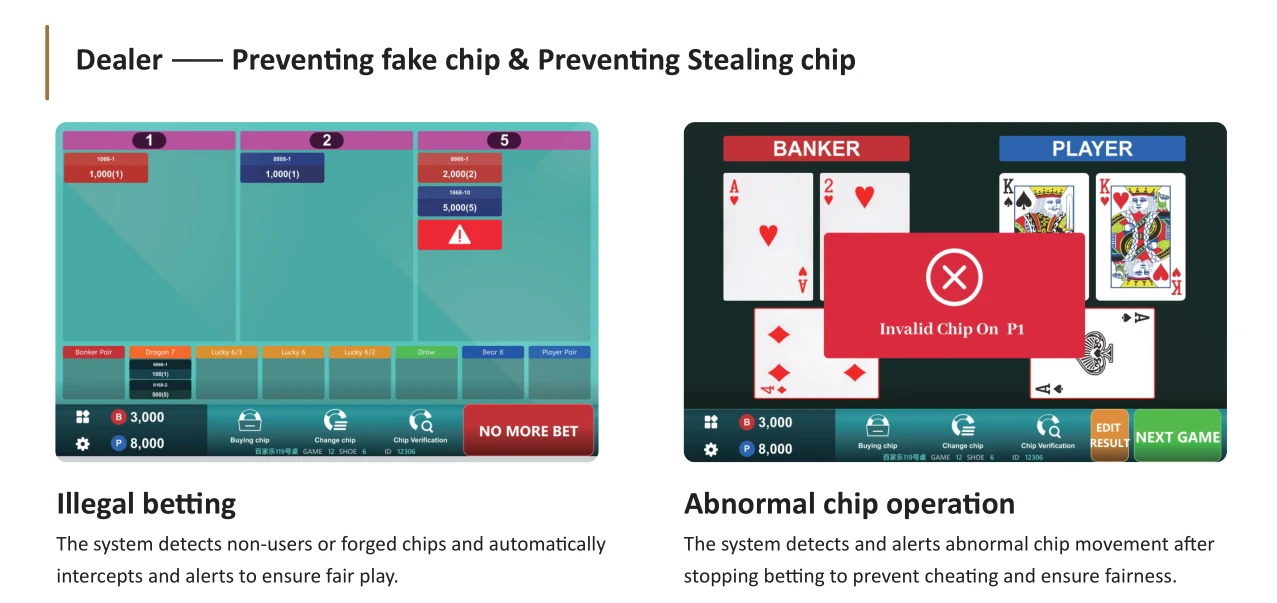
A baccarat round is not complete when the result is announced. It is complete only after losing bets are collected and winning players are paid correctly.
This is where payout verification becomes important.
If the system knows the bet amount and the result, it can calculate what should be collected and what should be paid. RFID chip reading can then help compare the expected amount with the actual chips handled by the dealer.
For losing bets, the system can compare:
Expected collection — the amount that should be collected based on the result
Actual collection — the chips actually collected by the dealer
For winning bets, the system can compare:
Expected payout — the amount the player should receive
Actual payout — the chips actually placed for payout
This is a practical control point. Many table issues do not come from misunderstanding the rules; they happen during settlement. A payout may be short, excessive or require supervisor review. A losing bet may be collected incorrectly. A later dispute may require video checking.
A payout verification function helps reduce this uncertainty by connecting the original bet, the game result and the final chip movement.
This is one of the areas where CTSOK CMS is more than a reporting system. It connects RFID chip recognition, bet data, AI card recognition and payout checking into the actual baccarat table workflow.
Suggested internal link: casino management system → CTSOK CMS product page
CMS Is Not Only a Back-Office Dashboard
Many people think of a casino management system as software that displays reports after the game. For table games, that view is incomplete.
In baccarat, the useful data is created at the table. If the CMS receives only delayed or manual information, it can show reports but may not fully explain the round-level process.
A table-connected CMS can record more of the operational chain:
Chip tray status
Denomination, quantity and total chip value before and during table operation.
Player chip exchange
Player ID, exchanged value and chip denomination.
Betting area recognition
Where chips were placed and how much was placed.
Card result recognition
Banker, Player or Tie result based on card data.
Settlement check
Expected collection, actual collection, expected payout and actual payout.
When these records are connected, the CMS becomes closer to the actual table operation. It is not only a place where reports are viewed. It becomes the system that organizes the round data from chip tray to payout.
What Casino Operators Should Actually Check
When evaluating baccarat table technology, it is not enough to ask whether the system uses RFID or AI. Those are only technical labels.
The more practical questions are:
Can the chip tray be checked by denomination and total value?
Can chip exchange be connected with player ID?
Can the table detect chips on Banker, Player, Tie and other supported betting areas?
Can the card result be recognized and linked to the bet?
Can the system calculate the expected collection and payout?
Can the dealer-side screen show the process clearly?
Can the final table record be reviewed later in the CMS?
These questions are closer to real table operation. A system that only reads chips solves one part of the problem. A system that only displays results solves another part. The stronger structure is a connected workflow where chips, players, bets, cards and settlement are part of the same record.
CTSOK CMS is designed around this kind of baccarat table workflow. It combines RFID chip data, smart table reading, player records, AI card recognition and payout verification to help casinos build a clearer table-level management process.